


PSMBasedQuantification
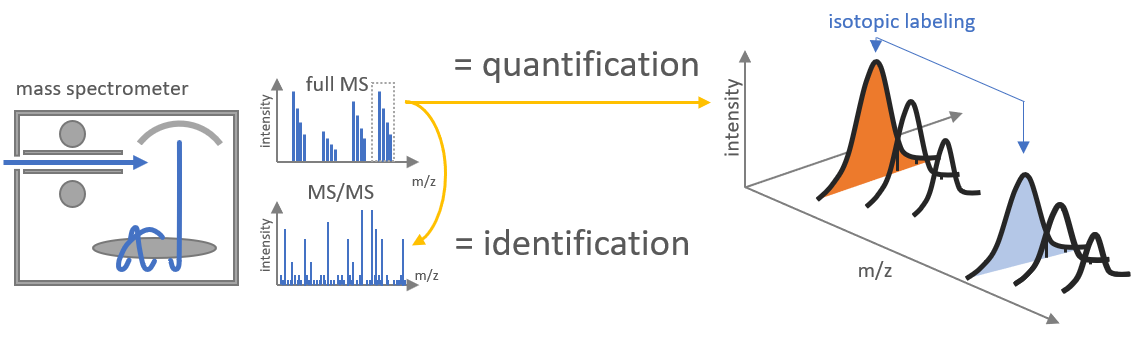
PSMBasedQuantification turns the identifications from PSMStatistics into peptide ion intensities. For every identified peptide ion (sequence, modification state and charge) it takes the scan times of its MS/MS identifications, extracts an ion chromatogram of the monoisotopic m/z in a window around them, detects the peaks in that trace and fits the peak closest to the identification. The fitted area is the reported quantity. For metabolically labeled samples the tool computes the m/z of the partner ion (the heavy form of a light identification, or the other way round) and quantifies that trace as well, so every row can carry a light and a heavy value.
Inputs and outputs
Flag |
Meaning |
Comes from |
|---|---|---|
|
one or more |
|
|
one or more |
|
|
the SQLite peptide database |
|
|
the output directory, created when missing |
|
|
the parameter file in JSON |
this page |
|
switch: pair files by base name instead of by position |
|
|
switch: write diagnostic charts |
|
|
switch: pack the chart directory into a zip file and delete it |
|
|
number of runs quantified at the same time, default 1 |
The input must be .mzlite. A directory given to -i is also scanned for .mzML, but the tool opens every file with the mzlite reader and fails on anything else, so convert first.
With one file per flag the pair is used as given. With lists, the n-th mzlite file is paired with the n-th qpsm file unless you pass -mf, which pairs files by their base name (run1.mzlite with run1.qpsm) and skips mzlite files without a partner.
For every run the tool writes run.quant, tab separated with a header and one row per quantified peptide ion. Next to the identifiers and the best q-value and PEP value of the ion it reports the fitted quantity (Quant_Light, Quant_Heavy), the apex intensity, the fit parameters, the difference between identification and fitted scan time, the extracted traces and the isotope pattern for both channels.
QuantBasedAlignment, AlignmentBasedQuantification, AlignmentBasedQuantStatistics and JoinQuantPepIonsWithProteins read .quant files.
With -dc the tool writes one chart per peptide ion into run_plots, plus mzErrorAndCorrection.html and precMzCorrected.html for the m/z calibration it derives from the identifications. -z packs that directory into run_plots.zip and deletes it. Delete an existing run.quant in the output directory before a rerun, the tool appends to it. Logs go to PSMBasedQuantification_log.txt and run_log.txt in the output directory.
Parameters
Parameter |
Default |
Meaning |
|---|---|---|
|
|
|
|
|
Marks qpsm input in the FragPipe layout, which PSMBasedQuantificationTIMs reads. Keep it at |
|
|
Half width of the scan time window around the identification that is extracted and searched for the peak, in the scan time unit of the run. |
|
|
Half width of the m/z window of the trace, in Da. |
|
|
Peak detection on the trace. The wavelet parameters are listed below. |
|
|
|
|
|
Asymmetric least squares baseline subtraction on the trace before peak detection. |
The wavelet parameters:
Parameter |
Default |
Meaning |
|---|---|---|
|
|
Number of points padded at both ends of the trace. |
|
|
How the border points are filled ( |
|
|
How small gaps inside the trace are filled. |
|
|
How gaps longer than |
|
|
Gap length from which a gap counts as huge. |
|
|
Peaks closer than this are merged. |
|
|
Smallest peak width the wavelet scales start at. |
|
|
Largest peak width the wavelet scales go up to. |
|
|
Quantile of the wavelet correlation used as noise level. |
|
|
A peak needs a correlation above |
The default file is QuantificationParams.json. To run without baseline correction set BaseLineCorrection = None in the script below.
Writing a parameter file
open ProteomIQon
open ProteomIQon.Domain
open FSharp.Stats.Signal

let waveletParams : WaveletParameters =
    {
        Borderpadding          = None
        BorderPadMethod        = Padding.BorderPaddingMethod.Random
        InternalPaddingMethod  = Padding.InternalPaddingMethod.LinearInterpolation
        HugeGapPaddingMethod   = Padding.HugeGapPaddingMethod.Zero
        HugeGapPaddingDistance = 100.
        MinPeakDistance        = None
        MinPeakLength          = Some 0.1
        MaxPeakLength          = 1.5
        NoiseQuantile          = 0.01
        MinSNR                 = 0.01
    }

let quantificationParams : Dto.QuantificationParams =
    {
        PerformLabeledQuantification = Labeling.N15Labeling
        FragPipe                     = false
        XicExtraction =
            {
                ScanTimeWindow = 2.
                MzWindow_Da    = Window.Estimate
                XicProcessing  = XicProcessing.Wavelet waveletParams
                TopKPSMs       = None
            }
        BaseLineCorrection = Some { MaxIterations = 10; Lambda = 6; P = 0.05 }
    }

// Replace the temp folder with your project folder.
let outputPath = System.IO.Path.Combine(System.IO.Path.GetTempPath(), "QuantificationParams.json")

Json.serializeAndWrite outputPath quantificationParams
Running the tool
Install with dotnet tool install --global ProteomIQon.PSMBasedQuantification, then quantify one run:
|
Several runs, paired by position in the two lists, three in parallel:
|
Two directories, paired by file name:
|
All flags:
|
namespace FSharp
--------------------
namespace Microsoft.FSharp
<summary> padds data points to the beginning, the end and on internal intervals of the data </summary>
<summary> padds data point at signals start and end </summary>
<summary> inserts random data points taken from the original data set </summary>
<summary> padds data point in small gaps (e.g. a missing data point or small ranges with no data) </summary>
<summary> inserts points lying on the linear interpolation of the two adjacent knots </summary>
<summary> padds data point in huge gaps (e.g. big ranges with no data) </summary>
<summary> inserts 0.0 as y_Value </summary>
module QuantificationParams from ProteomIQon.Dto
--------------------
type QuantificationParams = { PerformLabeledQuantification: Labeling FragPipe: bool XicExtraction: XicExtraction BaseLineCorrection: BaseLineCorrection option } member Equals: QuantificationParams * IEqualityComparer -> bool
<summary>Performs operations on <see cref="T:System.String" /> instances that contain file or directory path information. These operations are performed in a cross-platform manner.</summary>
System.IO.Path.Combine([<System.ParamArray>] paths: string array) : string
System.IO.Path.Combine(path1: string, path2: string) : string
System.IO.Path.Combine(path1: string, path2: string, path3: string) : string
System.IO.Path.Combine(path1: string, path2: string, path3: string, path4: string) : string